Aluminum is one of the most important industrial materials of our time. Aluminum and its alloys, which are the most preferred material after steel, appear in all areas of life. Aluminum is widely used in many industries such as construction, packaging, transportation, engineering and architecture.
Aluminum, which has reserves in many parts of the world, is a light, strong, flexible and recyclable metal. Aluminum, with its chemical and physical properties, is used in many areas from the packaging industry to transportation, from the engineering sector to architecture.
What is Aluminum?
Aluminum is a silver-colored and ductile metal. It is not found in the metal form in nature. The symbol for aluminum is Al and its atomic number is 13.
Aluminum is the third most common chemical element on the planet after oxygen and silicon. It makes up about 8% of the earth's crust.
Aluminum is not found in nature in metallic form like gold and platinum. Like iron, lead and tin, it occurs in nature in compounds. Aluminum can easily form compounds with other chemical elements. For this reason, a wide variety of aluminum alloys have been developed.
Aluminum has a wide range of uses in the construction, automotive, packaging, defense, industry and transportation sectors with its light structure, superior corrosion resistance, high degree of heat and electrical conductivity, and easy formability. Due to these properties, aluminum is the second most produced metal after iron and steel.
History of Aluminum
Aluminum has a history of more than 200 years. Aluminum, which was used in textile dyes and leather making in ancient times, has been used in different fields for thousands of years. However, aluminum has been known for its metal form for about 150 years. The separation of aluminum from its oxide compound took place in 1807. Later, many innovations occurred in the production of aluminum.
In the industrial production of aluminum, the studies of Charles Martin Hall in the USA and Paul Héroult in France in 1886 are considered to be the beginning. Unaware of Hall, who applied for a patent on the electrolytic production of aluminum in 1886, Paul Héroult developed the same technique in Europe. For this reason, the process defined as the Hall-Héroult process is the basic method used all over the world in the extraction of aluminum ore today.
What are the Properties of Aluminum?
The properties of aluminum can be listed as follows;
- Aluminum is a soft and light metal.
- It has a matte, silvery color.
- It is one of the most abundant elements on earth.
- It is almost three times lighter than iron. Although it is lighter than iron, it is extremely strong and flexible.
- Since its surface is covered with a strong oxide film layer, it is resistant to corrosion.
- It is resistant to weather conditions.
- It is resistant to liquids and gases.
- Aluminum can be easily forged, machined and shaped using pressure.
- It is non-flammable and does not require special paint. Unlike plastics, it is not a toxic substance.
- One hundred percent recyclable. It is widely preferred due to its recyclable feature.
How is Aluminum Produced?
Aluminum is obtained by the same method all over the world. Aluminum production takes place in two stages. Aluminum production begins with bauxite, the 'essence of aluminum'. Bauxite, a common mineral, is used as a primary raw material in aluminum production. Bauxite; It is a mineral containing oxides of iron, silicon, titanium, sulfur, gallium, chromium, vanadium, as well as various modifications of aluminum hydroxide mixed with iron, magnesium carbonate, and sulfuric calcium.
In the first stage of aluminum production, alumina is obtained from bauxite ore by the Bayer method. Bauxite is processed into alumina and aluminum oxide. Alumina is separated from oxygen by electrolysis. After the aluminum accumulates at the bottom, the process is completed.
Aluminum Alloy Series
Pure aluminum is a soft metal, so industry mostly uses alloys made by adding other elements. Wrought aluminum alloys are grouped into four-digit series by their main alloying element:
- 1xxx: At least 99% pure aluminum. Conductive and easy to form, but low in strength.
- 2xxx: Copper alloys. High strength; used in aerospace and machining.
- 3xxx: Manganese alloys. Common in sheet, roofing and cans.
- 4xxx: Silicon alloys. Mostly used as welding wire.
- 5xxx: Magnesium alloys. Resistant to seawater; used for boats and tanks.
- 6xxx: Magnesium and silicon alloys. The most suitable series for extrusion; most aluminum profiles are made of 6060, 6063, 6061 and 6082.
- 7xxx: Zinc alloys. The strongest series; used for aerospace and mold parts.
Primary and Secondary Aluminum
Aluminum produced from bauxite with the Bayer and Hall-Héroult processes is called primary aluminum. This process is energy-intensive, especially the electrolysis stage. Secondary (recycled) aluminum, made by remelting scrap, needs only about 5% of that energy. Aluminum does not lose its properties when recycled, which is why most of the aluminum ever produced is still in use today.
From Aluminum to Profile: Extrusion
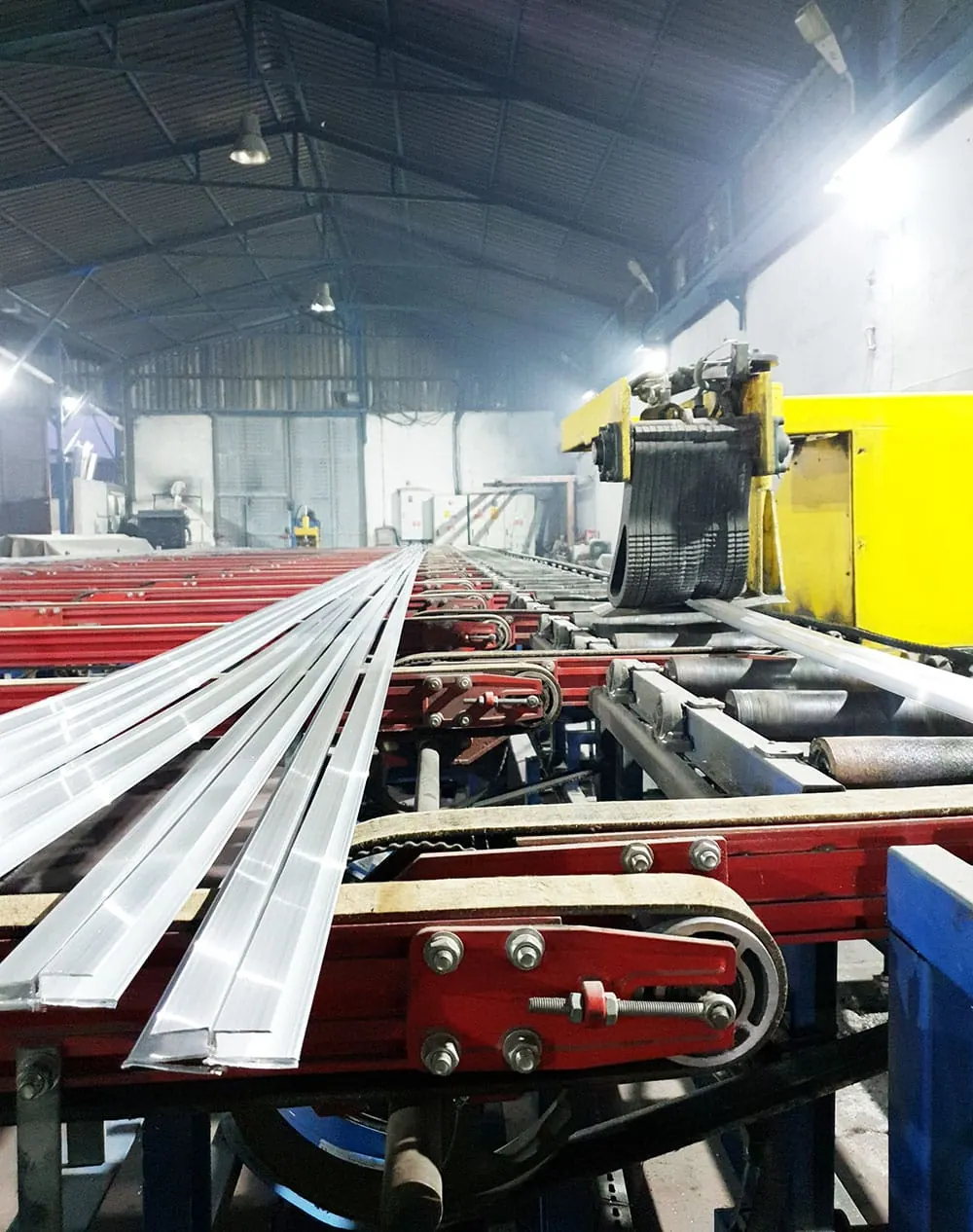
Molten aluminum from electrolysis is alloyed and cast into cylinders called billets. The billets are heated to about 450–500 °C and pushed in a press through a die with the desired cross-section. The profile coming out of the die is cooled, stretched straight, cut to length and aged in an oven to reach its final hardness. Then, if needed, it is powder coated or anodized.
Frequently Asked Questions
Is aluminum magnetic?
No. Aluminum is not attracted by magnets, which is an advantage in electronic and electrical applications.
What is the melting point of aluminum?
Pure aluminum melts at about 660 °C. Alloys melt over a slightly lower range depending on their composition.
How is aluminum produced in Turkey?
Primary aluminum production in Turkey is limited. Most of the industry produces semi-finished products and profiles from imported or local ingots and billets by extrusion, rolling and casting.